Portsmouth adopted a housing plan.
Now it has to get built.
Adopted September 28 after months of public pressure. Nineteen actions, some due within six months — and so far no posted schedule, no committee meeting, and no funding line.

PERMANENTLY AFFORDABLE WORKFORCE HOUSING — LIKE
RUTH LEWIN GRIFFIN PLACE ON COURT STREET
Where the plan stands
Reviewed against the adopted plan · 9 October 2026
The City Council adopted Portsmouth’s first Housing Action Plan on September 28. Nineteen actions are now city policy, several of them due within six months. What has not been set is a schedule: no Housing Committee meeting is posted for October or November, and no Council agenda through December 21 carries a plan item. The next real decision is money — the Capital Improvement Plan goes to a joint Council and Planning Board work session on November 12 and is adopted December 7.
It passed. Now fund the one thing that makes it last.
Most of the plan’s 19 actions make it easier or cheaper to build. Only two keep a home affordable over time, and adoption did not change that count. Portsmouth already knows how: Ruth Lewin Griffin Place on Court Street is what it looks like — the waiting list runs into the hundreds — and the approach the city chose for the Sherburne School is how it gets built: city land, a nonprofit builder, affordability that doesn’t expire. Make that standing practice, put it in the Capital Improvement Plan, and name the first site.
Say this — in the Council’s contact form, or at the mic
“I supported the Housing Action Plan and I’m glad the Council adopted it. Now please fund it. Put permanently affordable workforce housing on land the city already owns into the Capital Improvement Plan — the approach chosen for the Sherburne School — and name the first site.”
For the contact form, add: Please include this comment in the public record.
The Capital Improvement Plan is where the city commits capital spending; an action with no funding line is an intention. The form reaches all nine councilors — three of them sit on the Committee — and goes into the Council’s public record when it includes your name and address. If you rent your home, say so: the plan has no other way of hearing from you.
What’s in the plan
Nineteen actions — mostly changes to zoning that make it easier to build, plus tax incentives and a housing fund. Most of it is worth doing. Start with the one-page version; open the explorer if you want every action, what it does, and how it scores.
The 19 actions in plain English · one page (PDF) Open the Housing Action Plan Explorer — the 19 actions, scored
Also: the detailed scorecard (PDF) · the city’s full staff draft (PDF)
What’s missing
Does this produce a home that is still affordable in twenty years?
Only 2 of the plan’s 19 actions pass that test — not nearly enough to make a difference. Tax breaks expire, and the market reprices everything else at resale. Ruth Lewin Griffin Place on Court Street shows what lasting affordability looks like; the approach the city chose for the Sherburne School shows how to produce it: city-owned land, a nonprofit builder, and a permanent covenant. The plan, adopted September 28, still doesn’t make that standing practice.
What to ask for
Make it the city’s standing practice to build permanently affordable workforce housing on land the city already owns — fund it in the Capital Improvement Plan, and name the first site.
The city’s own study backs this up
A study the city commissioned — its Workforce Housing Evaluation, dated August 31, 2025 and released to the public with the September 10 meeting packet — finds the incentives on the books are unlikely to produce workforce homes on their own. The reason is simple math. An apartment a working family can afford brings in less rent than it costs to build and run — each one comes up roughly $22,000 to $46,000 short. That shortfall is about what the land under it costs: the same study puts land at $25,000 a unit across most of the city and $50,000 downtown. When the city contributes land it already owns, the gap closes — the homes stay affordable for good, and property taxes are not the source.
Close readers: the study and the plan, side by side (PDF) · the full study, on the city’s site (PDF)
What can I do? The plan passed. Now it has to get funded.
Two minutes is enough. Paste the sentences below into the Council’s contact form — one message reaches all nine councilors, three of whom sit on the Housing Committee, and it goes into the public record with your name and address. The Council adopted the plan on September 28. What it has not done is put money or a date behind it: the Capital Improvement Plan is where the city actually commits capital spending, and it goes to a joint Council and Planning Board work session on November 12 before adoption on December 7. An action with no funding line is an intention. If you rent your home, as half of Portsmouth does, say so — you’re the main beneficiary of this work, and the plan has no other way of hearing from you.
A household earning exactly the area median cannot afford the typical one-bedroom in Portsmouth today. On these figures a studio is the largest home that still fits.
“I supported the Housing Action Plan and I’m glad the Council adopted it. Now please fund it. Put permanently affordable workforce housing on land the city already owns into the Capital Improvement Plan — the approach chosen for the Sherburne School — and name the first site.”
For the contact form, add: Please include this comment in the public record.
Sources: City of Portsmouth Housing Action Plan, adopted by the City Council Sept. 28, 2026; RKG Associates, Workforce Housing Evaluation for the City of Portsmouth (Aug. 31, 2025), released with the Housing Committee meeting packet of Sept. 10, 2026; maximum affordable rent by bedroom from HUD FY2025 income limits for Portsmouth, as reproduced in that study; asking rent from the Progress Portsmouth Housing Snapshot, Oct. 9, 2026; Capital Improvement Plan dates from the City Council meetings calendar. Created with AI assistance in research and information design, with human editorial control.
When you have more time
The deep end: interactive tools, the monthly Housing Snapshot, plain-language guides, and the research behind everything above. It'll be here after the hearings, too.
Three homes where there was one.
While the big decisions get made at City Hall, ADUs and second units are by right on your street now. We condensed 40 pages of city rules into one guide.
Read the ADU guide →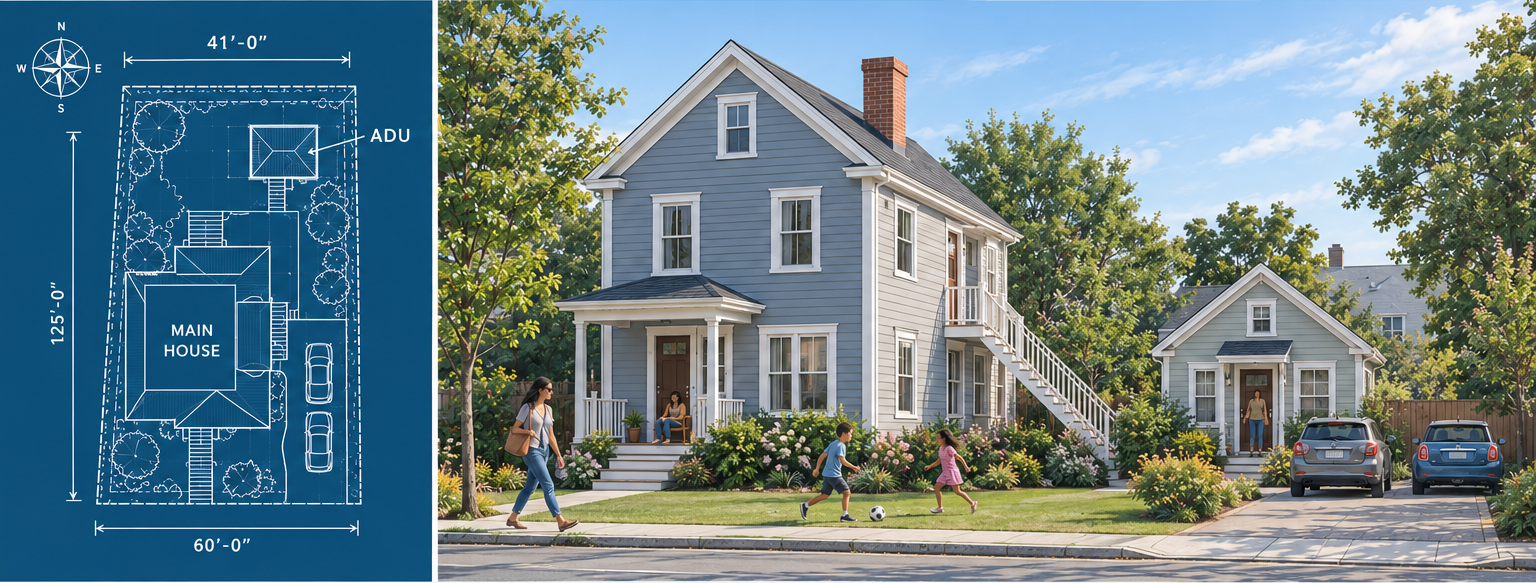
Opportunities worth exploring
Portsmouth’s housing decisions move fast. Our newsletter goes out when something happens — not on a schedule. No filler, no fluff.